

When the checkered flag falls on the Herr’s Potato Chips 200 at Lucas Oil Raceway, it will be the end of an era that dates back to the formation of stock car racing.
Since the time the first bootleggers souped up their cars, originally used to outrun law enforcement and later to race against one another, the steel body panels of the cars were stock, in fact, most of the actual car was as it was when it came off the showroom floor.
Tube-frame purpose-built racing chassis came into being in the 1960s, but racers still mounted stock bodies, albeit modified for racing, on them. That was the standard practice through the 1970s and into the 1980s.
Into the late 1980s, the cars used stock steel roofs, hoods, decklids, doors and fenders, although the nose and tail pieces were made of composite materials. In the 1990s, most of the stock car bodies went away from stock panels but were fabricated by the teams, out of steel, to match the profile of stock bodies. In the 2000s, when NASCAR went to aero-matched bodies, the last remnants of stock body panels went away in favor of one-hundred percent fabricated steel bodies with Kevlar nose and tail pieces.
In 2015, the ARCA Menards Series created a cost-cutting initiative that allowed a new flange-fit composite body supplied by Five Star Stock Car Bodies. The composite body panels could be replaced, even at the track. Rather than replacing an entire side, teams could replace only the damaged panels. While most of the top teams went to the new composite bodies immediately, or phased them in as they went through their steel body inventory, the smaller, independent teams continued to utilize the 2004-era steel bodied cars as often as they could.
In 2018, ARCA limited the use of the steel bodies to just the tracks one mile in length and under and informed the teams those cars would be phased out by the end of 2019. That means the final short track race of the season, coming up at Lucas Oil Raceway, will be the final go-round for the steel cars.
As is expected, with smaller budgets, the teams that utilize the older steel bodied cars haven’t had the budget to upgrade their chassis over the years.
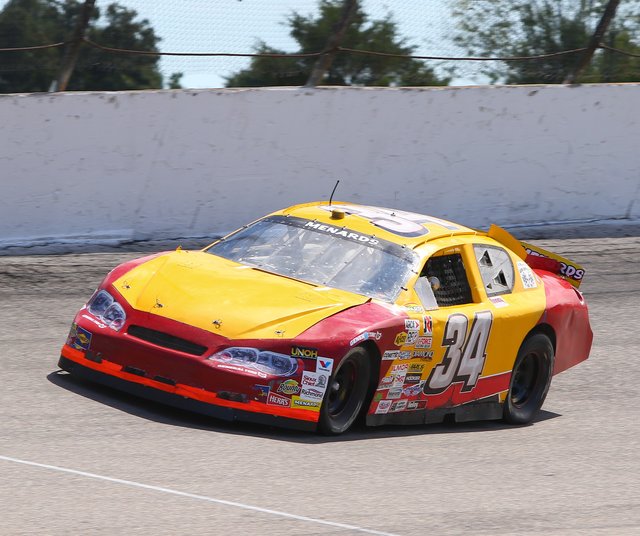 The Darrell Basham Racing team, with driver Mike Basham, brought their No. 34 Chevrolet to Salem Speedway last week, possibly for the final time. The chassis, which has been a part of Basham’s small fleet for over a decade, was originally built in 1999.
“It’s been a good car for us,” Darrell Basham said. “We had the chance to run some other cars. I got an old Ganassi car one time and we just left it sit there in the trailer because we really liked this one. That other car was pretty much brand new. Was only ever on the race track one time. They tested it and then decided they wanted to get rid of it and we got a hold of it. But we just stuck with this car. If we make it through Salem maybe we’ll take it up to Indianapolis for the final race. We’ll see.”
Mike Basham finished 13th at Salem, the car in one piece.
Others who have used steel-bodied cars in 2019 include Wayne Peterson Racing, with drivers Tim Richmond, Benjamin Peterson, Alex Clubb, and team owner Wayne Peterson. Richmond’s 11th-place at Toledo is the best finish for a steel-bodied car so far in 2019. Fast Track High Performance Racing’s Dick Doheny has piloted a steel-bodied car on the short track events, and finished a season-best 12th at Springfield. ARCA Menards Series stalwart Brad Smith has also entered his own steel-bodied Ford in every short track race he’s competed in this season. Eric Caudell made five starts in his steel-bodied Dodge with a trio of 13th-place finishes as his best. Dale Shearer has piloted a steel-bodied car in three races so far this season in conjunction with Kimmel Racing with a best finish of 14th at Elko. Barry Layne made a single appearance in the Kimmel Racing steel-bodied car at Nashville, finishing 18th.
The last top-ten finish for a steel-bodied car came last season at Kansas when Zach Ralston drove to a ninth-place finish. Joe Cooksey was the last driver to lead a lap in a steel car when he paced the field last September at DuQuoin for a single lap.
The last time a steel-bodied car scored a win was at Talladega in 2017 when Justin Haley drove the No. 28 MDM Motorsports Toyota to the win. That race was the last race at a restrictor-plate track in which composite bodied cars were not eligible to compete.
The ARCA Menards Series returns to action on Saturday October 5 with the Herr’s Potato Chips 200 at Lucas Oil Raceway. Practice starts the day’s activities at 2 pm ET, with General Tire Pole Qualifying at 5 pm ET. The 200-lap main event, scheduled for live broadcast MAVTV, will go green shortly after 8 pm ET. ARCA for Me members can access live timing & scoring, live chat, and live track updates at ARCARacing.com. New users can register for free with a valid email address at ARCARacing.com/login. Discounted adult general admission tickets are available through October 4 at Indianapolis-area Menards locations for just $20. For more information, please visit TrackEnterprises.com.



![visit Sunoco3c [converted] website - opens in the same window](https://www.arcaracing.com/wp-content/uploads/sites/36/2020/01/Sunoco3c-Converted-291x180.png "visit Sunoco3c [converted] website - opens in the same window")


