
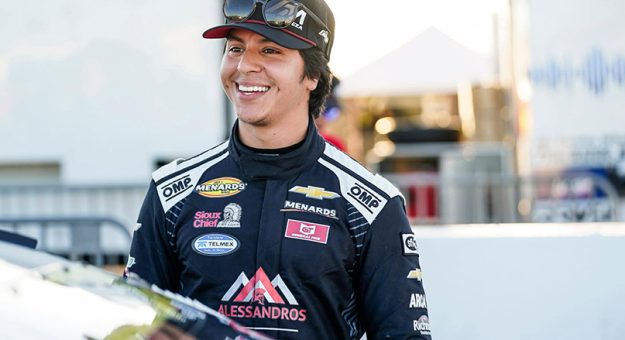
Helio Meza made a strong first impression with the ARCA Menards Series West on Oct. 2 at The Bullring at Las Vegas Motor Speedway. He qualified on pole in Pinnacle Racing Group’s No. 28 Chevrolet.
Those aware of Meza’s reputation as a driver were not surprised. The Houston, Texas native is in the middle of a standout season in the Trans Am Championship TA2 Series with eight victories in 11 starts. Meza also has a Late Model Stock victory at Tri-County Motor Speedway to his name.
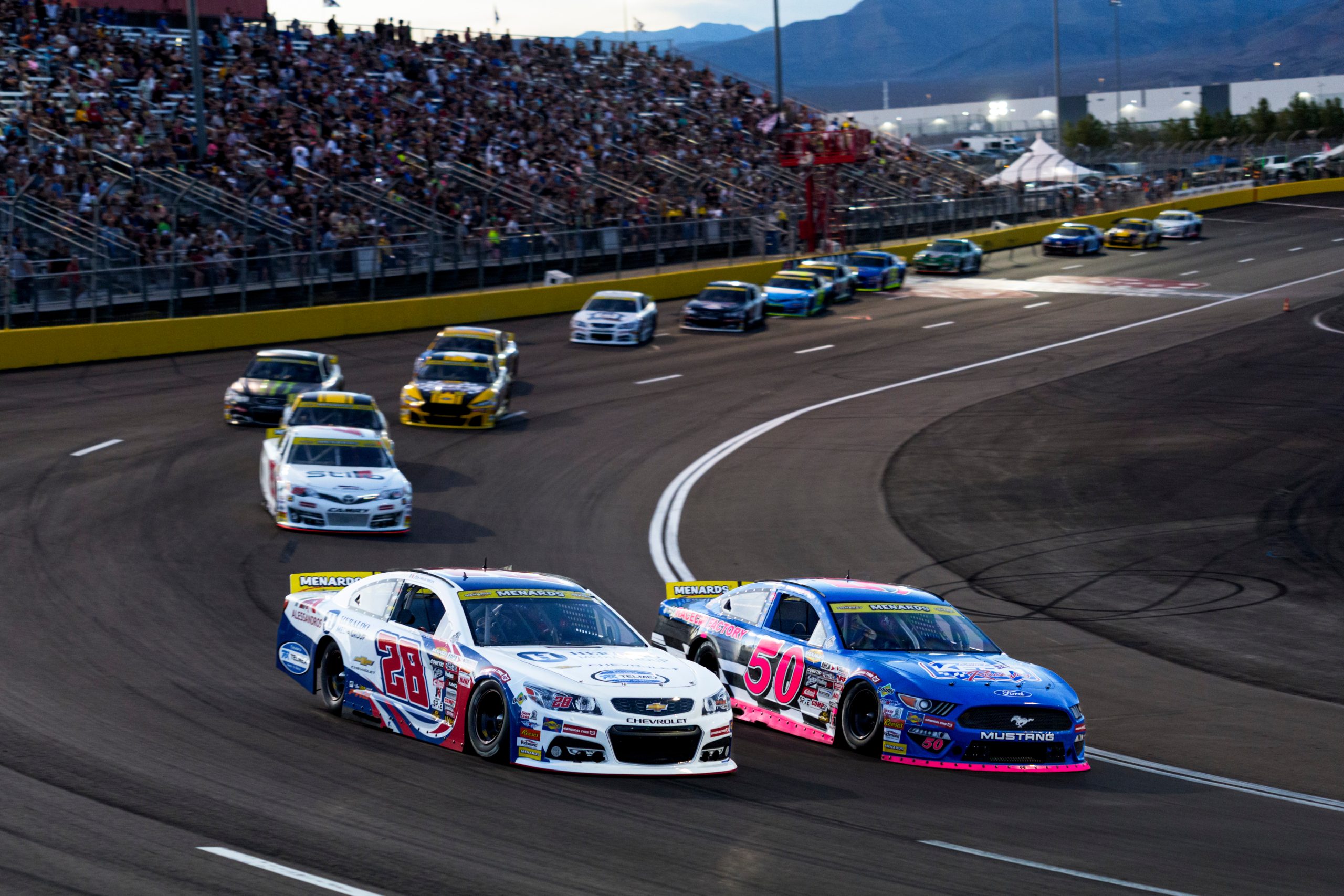
In that race at The Bullring, a flat tire following early contact with West Series points leader Trevor Huddleston prevented Meza from matching his qualifying performance. Yet he was thankful just to reach the ARCA Menards Series platform.
That’s because Meza was born deaf.
Every year has been a battle of perseverance and innovation to keep alive his dreams of being a racer.
WEST SERIES: Entry list for Saturday at Phoenix
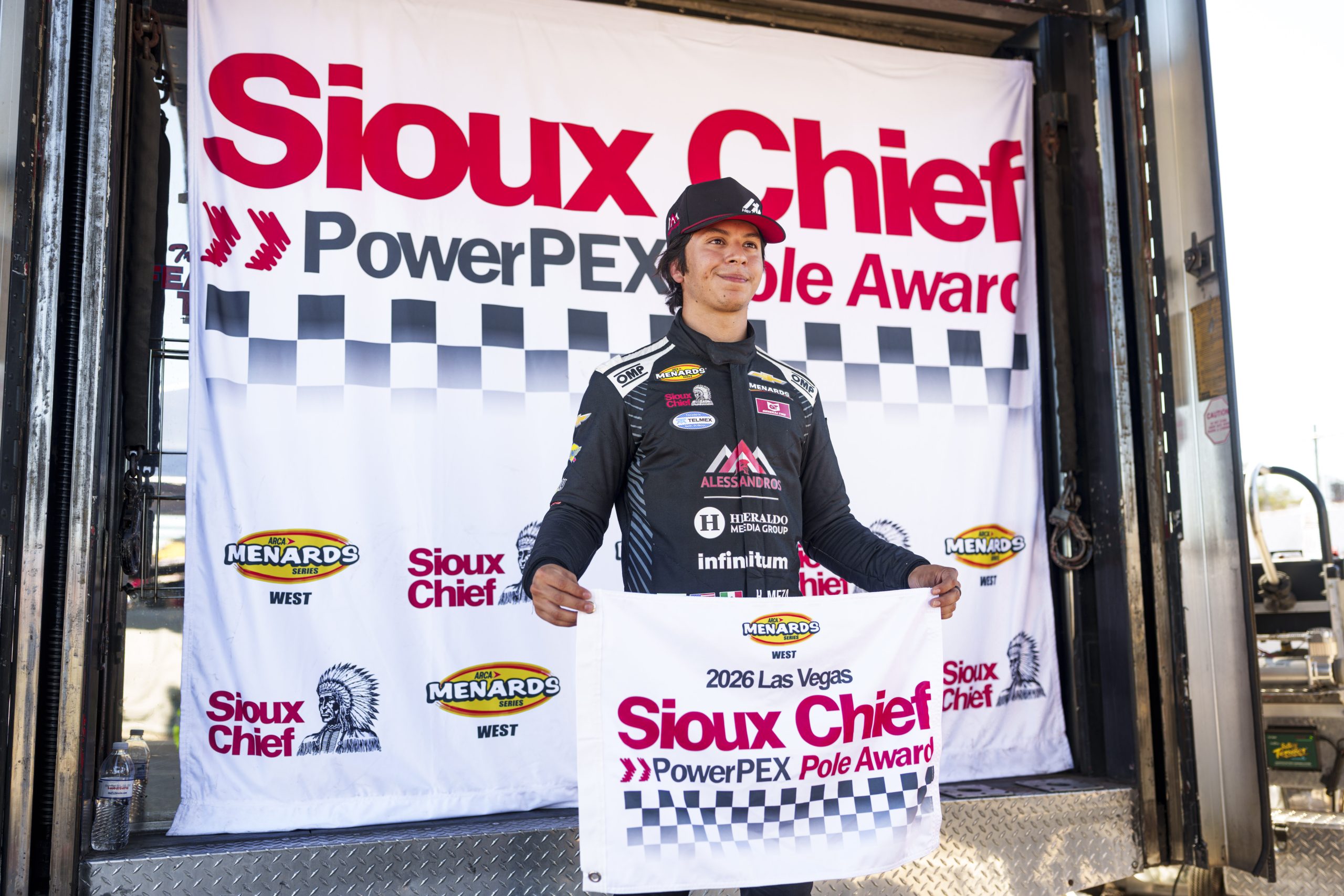
“For racing, it’s been a bit of a challenge,” Meza said. “I grew up road course go-karting. You don’t have a radio, so we never had to worry about communicating with the race team. When we were making the transition from go-karts to [full-bodied cars], the big thing is being able to communicate with your spotter and your crew guys.
“No one really in racing that we know has the condition that I have. Being born deaf and with my condition, I can’t wear the traditional ear plugs or ear buds.”
The condition is called bilateral microtia atresia. Meza was born without an inner ear, but the cochlea and ear drum remained intact.
When Meza was 3 months old, he was able to hear with bone conduction technology through a headband with a hearing aid, which he used until he was 7. Meza at age 8 had surgery to receive an implant that’s connected to the side of his head, which made hearing slightly easier.
As Meza’s racing career began to flourish, it quickly became apparent more would need to be done with his hearing for him to thrive in a professional environment. Meza and his father José reached out to numerous companies for advice on how Meza could receive and give feedback over the radio with his condition, but they did not find the proper answers.
That’s when José decided he would create his own in-race bone conduction system for his son.
One company the Mezas reached out to was Shokz, known for pioneering specialized headphones primarily used by runners and cyclists. The headphones built by Shokz are open-ear, meaning they sit on the side of a person’s head and vibrate the skull, which stimulates hearing.
Those headphones would not work in race conditions, as they would slide off under pressure and inertia. Yet with a little creativity, the Mezas managed to find a solution.
“What we did was we took the concept from that Shokz company,” Meza said. “[The headphones sit] on the side of your head and the transducers, the things that vibrate, they’re really small inside of there. We bought some third-party transducers and basically stripped them down. My dad got all these cables and we were able to tuck them into the padding of the helmet.
“When I slide the helmet on, these transducers sit on the side of my head and vibrate. With that vibration, I’m able to hear.”
Even with the bone conduction system inside his helmet, Meza said there’s still an ongoing struggle to obtain high-quality parts. When the transducers compress inside the car, particularly when Meza goes through turns, they lose their performance. So Meza wants components that can withstand constant pressure.
Improvements to the system have Meza confident he and his father have reached a solid baseline. That journey correlates almost perfectly with Meza’s developmental path, which now finds him on the precipice of his second West Series start in the Desert Diamond Casino West Valley 100 at Phoenix Raceway (Saturday, 8 p.m. MST/11 p.m. ET on FloRacing).
Meza felt he was prepared for his maiden West Series start at The Bullring despite being a road racer by trade. The Trans Am TA2 Series provided Meza and idea of what to expect in a stock car, but he also had the guidance of Chevrolet and Wise Optimization to rely upon, along with an efficient team in PRG.
Although he did not get the finish he wanted, Meza came away from The Bullring more confident in his ability to drive one of PRG’s cars.
“The big thing that surprised me was the car handled a lot better than I anticipated,” Meza said. “The only oval stuff I raced was some of the NASCAR Mexico stuff and some Late Model Stock races. [The ARCA car] is the heaviest car I’ve driven to date. It had its own little challenges, and I had to change a couple things driving-wise, but for the most part, it was all really natural to me.”
Meza’s second West Series appearance could not be any different than his first. Instead of a short oval like The Bullring, Meza is tackling the one-mile oval of Phoenix, a venue that has hosted NASCAR championship races.
The scale of Phoenix is not intimidating Meza in the slightest, especially in a PRG chassis. When the ARCA Menards Series platform last visited Phoenix in March, PRG swept the top two positions with Carson Brown leading every lap in the No. 28, the same car Meza will pilot Saturday.
Going wire-to-wire like Brown did is not Meza’s end goal, but he does believe he can contend for the win. Doing so will require Meza to utilize the resources around him and ensure all the preparation beforehand translates to consistency from practice until the checkered flag.
“At this point, the approach that has worked best for me is to not set too many expectations,” Meza said. “The track record the No. 28 car has had at Phoenix has been through the roof. I’m not worried about the pace being off with the team. It’s just going to be more on my end of learning as much as I can as quickly as I can.
“Whenever I know I’ve studied as hard as I could or have done everything I could to prep, it just makes me that much more confident going into the weekend.”
Meza anticipates some mistakes throughout the weekend. A flawed outing at Phoenix would not be the worst scenario, as any shortcomings will serve as tools for growth ahead of more planned ARCA Menards Series starts in 2027.
Overcoming obstacles has become a part of Meza’s routine. The equipment he raced in go-karts was not always the fastest, and his family often struggled to find the necessary funding for him to race nationally.
Combined with the meticulous effort exerted just for Meza to receive communication inside his helmet, no part of his journey has been easy. Yet Meza has never let hearing loss limit what he can do. He has endured every hardship and become stronger along the way.
With an impenetrable resolve and a collected mindset, Meza is ready to prove he can win in the ARCA Menards Series and beyond.
“Everyone at the end of the day has their own challenges,” Meza said. “Everyone goes through something different. I try and look at my situation the same way. The challenges [my family and I] have had to go through have shaped the work ethic, discipline and drive that I have to do the best that I can today.
“To even still be racing now and to say that I’m going to be racing Phoenix in an ARCA car is crazy. If you had told me that last year, I would have called you crazy.”
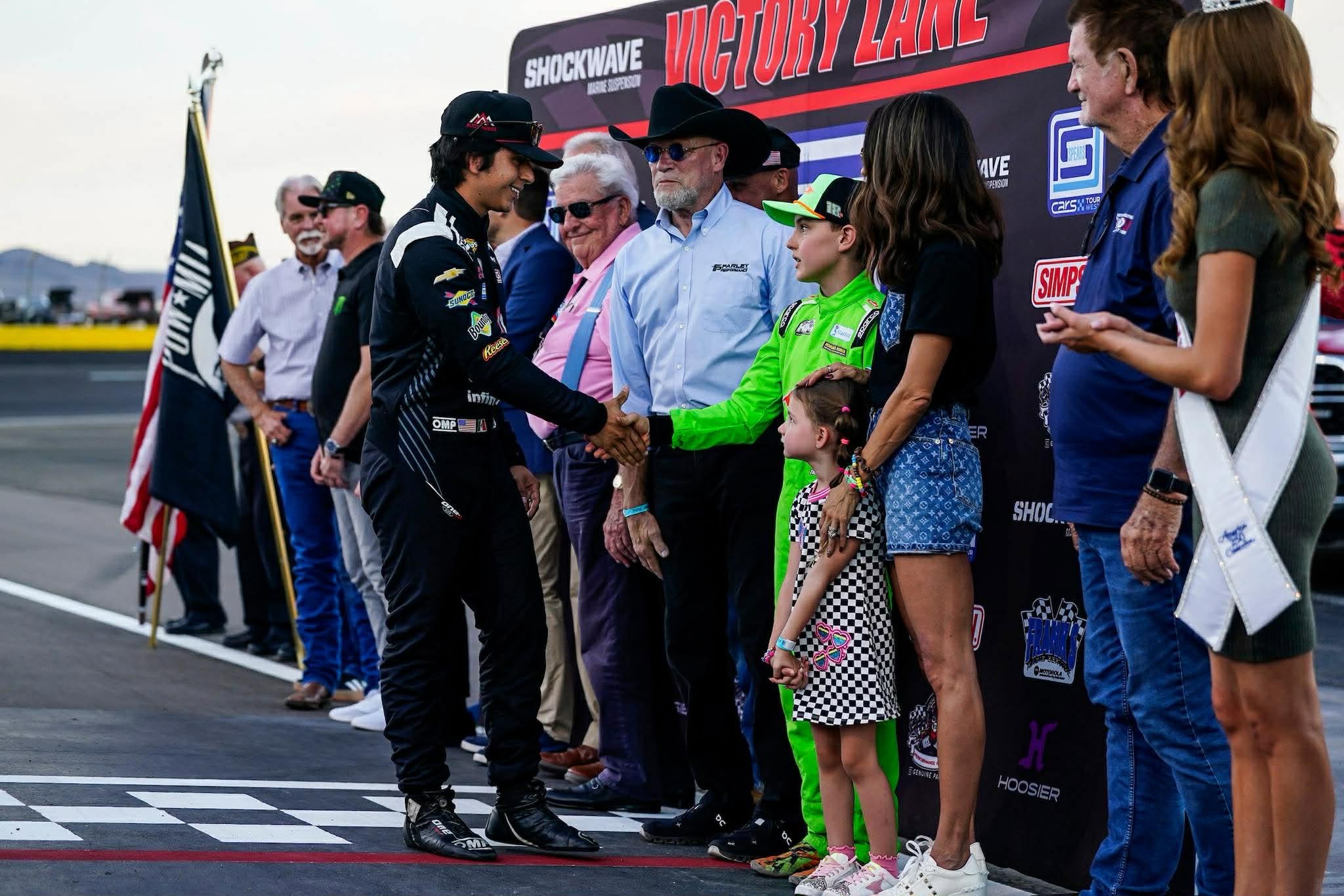
Meza’s hard work has led him to Victory Lane in two different countries, on road courses and on an oval. Now Meza is with one of the ARCA Menards Series’ best programs, embracing the noise as he continues building his reputation as a talented prospect.
And nothing was going to deny him that opportunity.


![visit Sunoco3c [converted] website - opens in the same window](https://www.arcaracing.com/wp-content/uploads/sites/36/2020/01/Sunoco3c-Converted-291x180.png "visit Sunoco3c [converted] website - opens in the same window")


